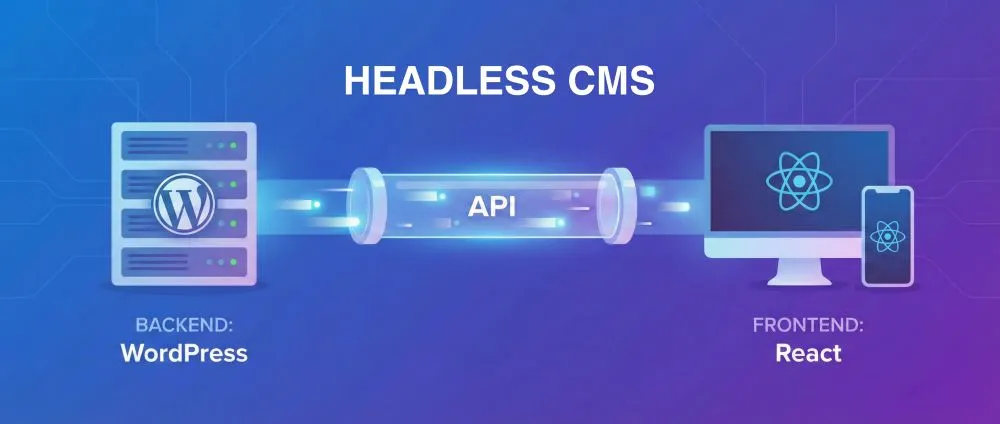
Speed, flexibility, and a seamless user experience are some of a modern website’s non-negotiable features. Blogging is fine with a regular WordPress, but its theme-based architecture may limit the frontend redesign and the performance. That is the reason why developers and businesses are moving to Headless CMS solutions – a system where the backend is still the content manager and the frontend is the one that delivers the gorgeous UI via frameworks like React.
In our case, we made WordPress a Headless CMS backend, and React (Vite) is the frontend that is connected through the WordPress REST API and is GraphQL powered for efficient data handling.
Such a move has led to unlocking of modern performance, the elimination of design limitations, and the creation of scalable architecture that is built for the future.
What is Headless CMS and Why It Matters Today
A Headless CMS is basically a system that alters the way we create websites. Rather than associating content with a style, it fetches content via APIs, thus enabling any frontend system to use it.
Such a decoupled structure allows:
● Faster loading and rendering
● Better control for developers
● Unlimited UI customisation
● Multi-channel content delivery (web, mobile, apps, IoT)
● Separate frontend-backend scalability
● Enhanced security and performance optimisation
Companies which desire a trendy UI without sacrificing the convenience of an admin dashboard consider Headless CMS architecture as the ideal way out.
The Limitations of Traditional WordPress Themes
WordPress themes follow a tightly coupled architecture — meaning content management and frontend design live in the same layer. While convenient, this system poses several challenges:
Limited frontend customisation
Themes often force developers into predefined layouts.
Slow site speed
Multiple heavy plugins and PHP-based rendering increase response time.
Difficult long-term scaling
Backend and frontend updates can interfere with each other.
No easy multi-platform scalability
Themes are designed only for websites — not mobile apps or custom digital platforms.
To remove these limitations, we rebuilt WordPress’ role, turning it into a content engine for a powerful Headless CMS setup.
Why We Chose a Headless CMS Approach
Major Benefits of a Website Powered by a Headless CMS
Moving from classic WordPress to a Headless CMS configuration gave major benefits:
1. Significantly Faster Website
React quickly renders the UI thus there are no waiting times for page refreshes and the user gets the impression of a smooth navigation.
2. Free From Theme Restrictions
The whole UI was developed in React without any WordPress design constraints.
3. Modular Component-Based Frontend
React components made it possible to have reusable dynamic elements such as:
● Blog listings
● Single blog pages
● Navigation menus
● Image galleries
● Product pages
● Contact forms
4. Independent Scaling
WordPress backend or React frontend can be updated separately without the risk of code breakage.
5. Better Security
The absence of a theme layer means fewer potential points of attack, while API-only access allows for better backend security.
6. Superior Developer Experience
Development was made faster by React + Vite and the developer could enjoy:
● Hot reloading
● Super fast build time
● Improved code debugging
● Neat folder structure
● Modern dependency management
● Optimized production bundles
An outcome of this is a website utilizing a Headless CMS system that is not only well-organized and contemporary but also prepared for the future.
Tech Stack That Powered Our Headless CMS
Backend: WordPress
WordPress served purely as a content manager storing:
● Blog Posts
● Pages
● Featured images
● Categories and tags
● Media uploads
● Dynamic slugs
● Menu hierarchy
We accessed all this structured content using the WordPress REST API — converting WordPress into a true Headless CMS backend.
Frontend: React + Vite
React delivered:
● Dynamic routing using slugs
● Homepage UI rendering
● Blog page structure
● Product page display
● Form integration
● Media and image rendering
● API fetching and state management
Vite supported blazing speed during development and optimised builds for production.
Enhancement: GraphQL
Switching to WordPress GraphQL helped us reduce API complexity by fetching all data through a single query instead of multiple endpoints — making our Headless CMS data flow cleaner and faster.
Major Challenges When Converting WordPress Into a Headless CMS
Implementing the Headless CMS wasn’t straightforward initially because WordPress is designed for themes. We encountered multiple roadblocks while fetching and syncing data.
1. Multiple endpoint API calls slowed performance
We had to call different URLs for posts, menus, forms, and media.
Solution: Introduced GraphQL — allowing us to fetch everything in one structured query.
2. CORS policy errors
React blocked API requests from WordPress due to cross-origin restrictions. Solution: Enabled proper CORS headers and API permissions in WordPress.
3. Broken and missing images
WordPress stored image paths in formats not easily readable by React.
Solution: Built helper functions to generate complete image URLs and fallback image handlers.
4. Unformatted API content
WordPress content returned in raw HTML format.
Solution: Used HTML parsers in React to render text safely and formatted backend content before API output.
5. Heavy plugins slowed down API response
Too many plugins affected performance.
Solution: We optimised and removed unnecessary plugins to keep WordPress lightweight.
Implementation — Step-by-Step Integration
Once challenges were solved, implementation became clean and effective:
1. WordPress entered content via admin panel
2. React fetched content using REST API and GraphQL
3. React pages rendered dynamic routes via slugs
4. Menus and media were pulled and parsed using helper tools
5. Continuous testing ensured both ends stayed in sync
Core Learnings From Our Headless CMS Journey
Through this project, we learned that:
Simplicity wins
Using only essential WordPress features improves speed.
APIs control success
A well-structured backend API ensures smooth frontend rendering.
GraphQL boosts performance
One query can fetch all content efficiently.
Frontend frameworks unlock innovation
React brings a modern UI that themes can’t match.
Scaling should never break innovation
Headless lets both the frontend and backend grow independently.
Final Thoughts — Why This Headless CMS Setup Was Worth It
By changing WordPress to function as a Headless CMS backend and combining it with React(Vite) resulted in.
● Out of the ordinary speed
● Contemporary
● Neat architecture
● Non-developers content control made simple
● Ability to grow indefinitely
At present, the website is more than just a page -it is a powerful platform running on the full potential of Headless CMS architecture.
For the teams that prioritize content freedom and UI quality, Headless CMS is not only better- it is the last CMS upgrade you will ever need.